The Supreme Court has sought the Uttar Pradesh government's response on a plea challenging certain provisions of the 2024 amended UP law on unlawful religious conversion, citing concerns about free speech and religious propagation.
The Supreme Court has initiated a suo motu case regarding investigation agencies summoning lawyers and will examine if they can be put to notice. The action follows the Enforcement Directorate summoning senior lawyers, which was condemned by bar associations.

The new bench comprises Chief Justice of India Ranjan Gogoi and Justices S A Bobde, D Y Chandrachud, Ashok Bhushan and S A Nazeer.
A five-judge constitution bench headed by Justice N V Ramana pronounced the order.

"Considering the importance of the matter, subject to the order of the Chief Justice of India, the matter be placed for final hearing on July 22," the bench said.
'Anyone they don't like can be potentially arrested and thrown in jail for 30 days to induce regime change.'
'His willingness to take the initiative to fight for truth and justice and his willingness to cross swords with anyone for a just cause.'

On the admissions, he said 26 people were treated in the OPD and were discharged. And of the 67 admitted as in-patients, 2 were critical. All others were stable. One of the patients was shifted to the Madurai GH for further treatment.
Not ordering disclosure of details of electoral bonds prior to April 12, 2019, was a "conscious choice" by the Constitution bench, the Supreme Court said on Monday while refusing to entertain the submissions of ASSOCHAM and CII against the disclosure of bond details on the ground of their plea not being listed.
The Supreme Court questioned Justice Yashwant Varma regarding his plea to invalidate an in-house inquiry panel report that indicted him after a large amount of burnt cash was discovered at his official residence during his time as a Delhi High Court judge.
The Supreme Court declined to examine a plea challenging a PMLA provision, stating the issue lies in the law's abuse, not the law itself. The court allowed the petitioner to approach the High Court if procedures weren't followed.
Swamy Shraddananda, jailed for 30 years for killing his wife, has moved the Supreme Court seeking authorities to decide his mercy plea before the President in December, 2023.

The bench said the petition has relied on a March 2 verdict of the apex court which had ruled that the appointment of the Chief Election Commissioner and ECs will be done by the President on the recommendation of a committee, comprising the prime minister, Leader of the Opposition in Lok Sabha and the CJI, to maintain the "purity of election".
'Devendra Fadnavis is stating that Marathas must feel OBCs are not happy with reservations for the Marathas and therefore they are protesting.'

The Centre on Wednesday told the Supreme Court that nobody can claim right over government land and it is legally empowered to reclaim properties which are declared waqf by using the waqf by user principle.

The Chhattisgarh High Court has ruled that anti-Naxal operations, as part of regular counter-insurgency measures, should not be investigated by a Special Investigation Team (SIT) unless exceptional circumstances justify such intervention. The ruling came as the court dismissed a petition seeking an SIT probe into the killing of a Maoist leader in Narayanpur district.

The Aligarh Muslim University's minority status issue will have to wait to reach a logical end after the Supreme Court majority verdict on Friday asked a regular bench to decide the issue.

Reliance Foundation's Vantara has pledged full cooperation with the Supreme Court-appointed SIT investigating allegations of legal non-compliance and animal acquisition irregularities.

A bench of Justices Surya Kant and Joymalya Bagchi is likely to take up the matter in which the EC has justified its ongoing SIR of electoral rolls in Bihar, saying it adds to the purity of the election by "weeding out ineligible persons" from the electoral rolls.
The Supreme Court said on Thursday it will examine the larger constitutional issue of challenge to the validity of extrajudicial divorce like 'talaq-e-hasan' among Muslims.
The Supreme Court is scheduled to hear a plea for the restoration of statehood to Jammu and Kashmir. The plea highlights the delay in restoration and its impact on democratic rights and development.
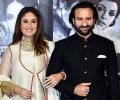
The Supreme Court has temporarily halted a High Court order that would have sent a decades-old property dispute involving the Bhopal royal estate back to trial court. The case involves descendants of Nawab Hamidullah Khan and challenges the inheritance of Sajida Sultan and her heirs, including actor Saif Ali Khan.

The State Bank of India, which unsuccessfully sought extension of time till June 30 to disclose the details of electoral bonds, on Monday faced searching questions from the Supreme Court which wanted to know about the steps taken to comply with the directions it had issued while scrapping the controversial scheme of anonymous political funding on February 15.

Justice Sanjiv Khanna, who has been part of several landmark Supreme Court judgements such as scrapping the electoral bonds scheme and upholding abrogation of Article 370, will be sworn in as the 51st Chief Justice of India on Monday.
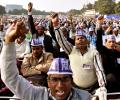
The Union Cabinet, at a meeting chaired by Prime Minister Narendra Modi, held a detailed discussion on the Supreme Court judgement on the sub-categorisation of reservation for SCs and STs as granted in the Constitution.

Underscoring the 'presumption of genuineness' of Aadhaar and voter ID, the Supreme Court on Monday refused to stay the publication of draft electoral rolls in poll-bound Bihar and said it would once and for all decide pleas against Election Commission's special intensive revision (SIR) of electoral rolls.

The Supreme Court has directed the Election Commission to provide details regarding the approximately 65 lakh voters removed from the draft electoral rolls in Bihar, a state preparing for elections. The court's order comes in response to a petition filed by an NGO challenging the Election Commission's Special Intensive Revision of electoral rolls.

The Supreme Court on Monday said citizens must know the value of the right of freedom of speech and expression, and exercise self restraint as it mulled guidelines to regulate offensive social media posts.

The Supreme Court has stated it will intervene if there is mass exclusion in the special intensive revision of electoral rolls in Bihar, emphasizing the Election Commission's role as a constitutional authority.

The Supreme Court on Friday refused to entertain a fresh plea challenging constitutional validity of the Waqf (Amendment) Act, 2025.

The Supreme Court of India has censured BJP MP Nishikant Dubey for his remarks against the judiciary, stating that his comments "tend to scandalize and lower the authority of the Supreme Court of India." The court dismissed a contempt petition against Dubey but issued a scathing order criticizing his remarks, which included accusations that the court was "taking the country towards anarchy" and that Chief Justice Sanjiv Khanna was "responsible for the civil wars taking place in the country." The court deemed Dubey's statements "highly irresponsible" and indicative of an attempt to "incite religious wars." The order highlighted the importance of maintaining public confidence in the judiciary and condemned attempts to undermine its authority.
The bench refused to entertain the plea filed by NGO Association for Democratic Reforms and dismissed it.
The Supreme Court on Friday observed the 1976 amendment to the Constitution adding terms 'socialist', 'secular' and 'integrity' to the Preamble underwent judicial reviews and it cannot say whatever Parliament did during the emergency period was all nullity.
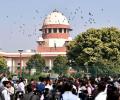
The Supreme Court has begun hearing petitions challenging the Election Commission's decision to conduct a special intensive revision exercise in Bihar ahead of elections, raising concerns about voter exclusion.
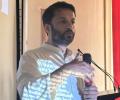
Acting on the Supreme Court's direction, Haryana's Director General of Police Shatrujeet Kapur has constituted a Special Investigation Team (SIT) to investigate two FIRs against Ashoka University associate professor Ali Khan Mahmudabad. The SIT, headed by Additional Director General of Police (Crime) Mamta Singh, will include Superintendent of Police (Karnal) Ganga Ram Punia and Superintendent of Police (STF, Gurugram) Vikrant Bhushan. The SIT will expeditiously complete the investigation and submit a report at the earliest. Mahmudabad was arrested on May 18 for his social media posts on Operation Sindoor, which were alleged to have endangered the sovereignty and integrity of the country. The Supreme Court granted him interim bail on Thursday, but refused to stay the investigation.

The Uttarakhand high court has asked two top officials of the state to find out whether an officer who has no knowledge of English can effectively control an executive position after an additional district magistrate responded in Hindi during the hearing of a public interest litigation (PIL).

The Supreme Court of India has directed changes in digital know your customer (KYC) guidelines for persons with disability and acid attack survivors, citing the right to digital access as an intrinsic component of the right to life under Article 21 of the Constitution. The court found that existing KYC procedures, which require visual tasks such as head movements and facial positioning, pose significant challenges for these groups, preventing them from accessing essential services like bank accounts and welfare schemes. The court emphasized the importance of bridging the digital divide and ensuring universal accessibility to digital services for all citizens.

In a landmark verdict, the Supreme court fixed a timeline for Governor to act on bills passed by the state legislature as it pulled up Tamil Nadu Governor R N Ravi for reserving 10 bills for President's consideration, saying it was against the constitutional provisions.

The Lok Sabha witnessed chaotic scenes as opposition members protested the introduction of three draft laws, leading to torn bills, sloganeering, and adjournments.

How does it matter for people whether the Aligarh Muslim University is a minority institution or not when it has continued to be an institute of national importance without the minority tag, the Supreme Court said on Thursday as it underlined that the intent of Article 30 of the Constitution is not to "ghettoise the minority".
